.svg)

What SWOT analysis is, how to run one, real examples and templates - and the data on why most SWOTs never become action.
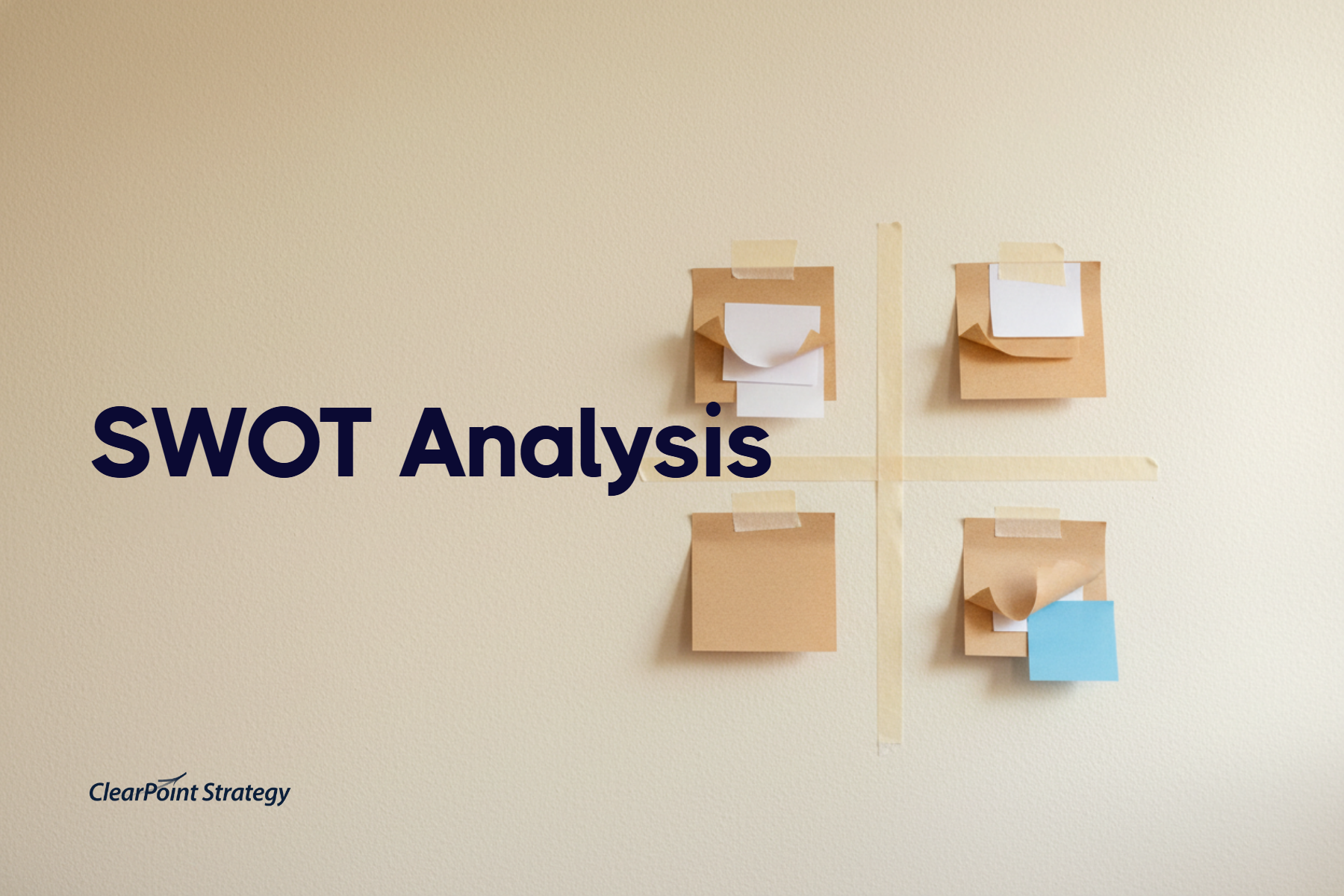
A whiteboard in a conference room. Four quadrants in marker. Strengths, Weaknesses, Opportunities, Threats. Forty sticky notes. Everyone nods. Someone photographs it on their phone.
- A SWOT is an honest snapshot of your situation before deciding what to do next, separating internal strengths and weaknesses from external opportunities and threats.
- The most common failure is stopping at four tidy lists; a plain SWOT describes your situation but never tells you what to do.
- The TOWS matrix, introduced by Heinz Weihrich in 1982, closes that gap by pairing internal and external factors into concrete strategic moves.
- Run SWOT as a process, not a brainstorm: define the objective first, get the right people in the room, and scope it tightly.
- Evidence from 17,700 real strategic plans shows most SWOTs stall on the whiteboard; the fix is owning each insight and linking it to action.
The photo is never opened again.
We wanted to know how often that actually happens, so we looked at our own data — every active strategic plan running on the ClearPoint platform. More than 17,700 of them, across 560+ organizations. The number that fell out is the reason this article exists: of the people put in charge of a strategic item, 76% never record a single update. Three out of four. The analysis gets made. Then nothing.
So this guide does two things. It explains SWOT properly — the definition, the matrix, the examples and templates you came for. And it shows you, with real numbers, why most SWOTs quietly die — and how the ones that don't are built differently.
A SWOT analysis is a strategic planning technique for assessing four things about an organization, project, or person: internal Strengths and Weaknesses, and external Opportunities and Threats. You map them in a 2×2 grid to see where you stand, then decide what to do about it.
SWOT stands for:
- S — Strengths: internal advantages you control (a strong brand, skilled staff, healthy cash).
- W — Weaknesses: internal limits that hold you back (high turnover, thin margins, aging tech).
- O — Opportunities: external openings you could seize (a new market, a shift in demand, fresh funding).
- T — Threats: external risks that could harm you (a new competitor, regulation, a downturn).
Two axes organize it — internal vs. external, and helpful vs. harmful:
Strengths and Opportunities help you. Weaknesses and Threats hurt you. Strengths and Weaknesses live inside your walls. Opportunities and Threats live outside them, whether you like it or not.
What a SWOT analysis is — and the mistake that kills it early
A SWOT is an honest snapshot of your situation before you decide what to do next. It forces two questions teams skip. What do we actually have to work with? And what is the world about to do to us?
The distinction that does the real work is internal versus external. Strengths and weaknesses are internal — your people, product, processes, cash. You can change them. Opportunities and threats are external — the market, the economy, the regulation. You cannot change them. You can only see them coming.
Most weak SWOTs fail right here. A team writes "the economy is uncertain" under Weaknesses. The economy is not your weakness. It is a threat — external, outside your control. Get the axis wrong and the whole exercise drifts. (The same grid works for a company, a hospital, a city, or your own career — only the contents change.)
The four components of SWOT
Each quadrant answers a different question. Here is what goes in each, with the prompts teams actually use.
Strengths (internal, helpful). What do you do better than anyone else? Ask: What do we do well? What unique resources do we have? What do others see as our strengths? Be specific. "24/7 support staffed by certified engineers" beats "good customer service."
Weaknesses (internal, the honest part). Where do you lose? Ask: What could we improve? Where are we short on resources? What costs us deals, time, or money? The entries nobody wants to say out loud are the ones that matter.
Opportunities (external, helpful). What is happening out there you could ride? Ask: What trends could we use? What gaps are open? Is anything changing — tech, regulation, demand — in our favor?
Threats (external, harmful). What could go wrong from outside? Ask: What is the competition doing? What economic or regulatory shifts could hurt us? What threats do our weaknesses leave us exposed to?
The SWOT origin story almost everyone gets wrong
Search for where SWOT came from and you will read the same line everywhere: a man named Albert Humphrey invented it at the Stanford Research Institute in the 1960s. It is repeated as settled fact on hundreds of pages.
It is not settled. The careful version is better.
In 2023, three researchers — Richard Puyt, Finn Lie, and Celeste Wilderom — published "The origins of SWOT analysis" in Long Range Planning. They read the original reports and interviewed the people involved. Two findings upend the popular story.
First, the technique did not begin as SWOT. It began as SOFT — Satisfactory, Opportunities, Faults, Threats — at the Stanford Research Institute in the mid-1960s. And the person they credit is Robert Franklin Stewart, who led the work. Humphrey was a participant, not the inventor. Most of the "Humphrey invented SWOT" story traces back to a memoir Humphrey circulated decades later, not to the 1960s record.
Second, the academic version is also shaky. Many textbooks credit four Harvard professors and their 1965 book Business Policy: Text and Cases. Puyt and his colleagues call that an "academic urban legend." The book uses the underlying ideas but contains neither the SWOT acronym nor the 2×2 matrix.
The acronym itself first appears in print in 1972, in a paper by a British consultant named Norman Stait. The famous strategy-pairing version — the TOWS matrix — comes later still, from Heinz Weihrich in 1982.
Why spend four paragraphs on history? Because it is the same lesson the rest of this article keeps proving. The popular answer is the easy one. The accurate one takes more work and is worth more. If a guide tells you Humphrey invented SWOT in the 1960s, it copied the myth.
Who actually invented SWOT — the short version:
- ~1965 — SOFT (Satisfactory, Opportunities, Faults, Threats) emerges at the Stanford Research Institute, under Robert Franklin Stewart.
- 1972 — the acronym "SWOT" first appears in print, in a paper by British consultant Norman Stait.
- 1982 — Heinz Weihrich adds the TOWS matrix, the missing action step.
Not Albert Humphrey. Not Harvard. The myth is only easier to repeat.
How to do a SWOT analysis, step by step
Run it like a process, not a brainstorm with a grid on top.
- Define the objective first. A whole company? One product? A market-entry decision? A vague scope produces a vague SWOT.
- Get the right people in the room. A solo SWOT is one person's blind spots, formatted. Pull in a cross-functional group. In the public sector, add outside stakeholders and a neutral facilitator.
- Fill the quadrants. Internal first (Strengths, Weaknesses), then external (Opportunities, Threats). Write specifics, not adjectives.
- Prioritize. This is where teams stop too early. Score each item as a group. Keep the top three to five per quadrant. Cut the rest.
- Convert it into action. A finished grid is the start, not the finish. That next step has a name.
From matrix to strategy: the TOWS matrix
Here is the gap nobody warns you about. A plain SWOT describes your situation. It does not tell you what to do. You end up with four tidy lists and a quiet question: now what?
The TOWS matrix answers it. Heinz Weihrich introduced it in 1982. The idea is simple and a little brilliant: take the same four lists and pair them to generate strategies.
A quick example. A small video-production firm has a strength — a creative reputation — and an opportunity — short-form video demand exploding. The SO move writes itself: build a short-form package that rides the reputation into the new demand. It also has a weakness, a tiny marketing budget, against a threat, big agencies undercutting on price. The WT move: pick a niche the big agencies ignore, so you are not fighting them head-on.
One note, because it confuses people. "TOWS" is "SWOT" reversed, and some sources use them interchangeably. In practice, TOWS means this strategy-pairing step — the part that comes after the SWOT. Most popular SWOT guides skip it entirely. That omission is the single biggest reason their readers' analyses go stale.
Where SWOT breaks down — the evidence
Now the honest part, and the reason we started this piece in our own database. SWOT has been criticized, hard, by people who study strategy for a living. The criticism is not theoretical. You can watch it in the data.
The flagship critique has a memorable title. In 1997, Terry Hill and Roy Westbrook published "SWOT Analysis: It's Time for a Product Recall" in Long Range Planning. They studied SWOT use across 50 companies. The exercises produced long, unprioritized lists — more than 40 factors on average. Entries were vague, single words, no data behind them. Nobody verified them. And the killer finding: the outputs were almost never used in the later stages of strategy.
That was 1997. Here is 2026, from our platform.
We pulled every active strategic plan on ClearPoint — 17,700+ of them, across 560+ organizations, holding over 70,000 objectives and 359,000 measures — and asked one plain question: once the plan exists, does anyone keep it alive?
Of the people assigned to own a strategic item, 76% have never recorded a single update. Named the owner. Never came back. The 1997 finding, alive and well.
It compounds. Only about one in four performance measures is ever evaluated against a target. The number gets created. The status — on track, at risk, off track — never gets set. The median organization is carrying 50 objectives and 128 separate measures across 15 plans. Most of it sits unscored. Hill and Westbrook's "40 factors no one uses," at scale.
Break the ownership gap down by sector and it gets stranger.
Education and financial services are the worst: more than four in five owners never update a strategic item. Utilities and energy are the most disciplined — and even there, 56% never come back. Healthcare sits at 64%, government at 77%, the private sector at 79%. Same framework everywhere. Wildly different follow-through. And the floor is brutal: in no sector do even half the owners stay active. The grid is never the problem. What happens after it is.
The academics had a second objection, too. Writing in 2001, Steven Valentin argued that standard SWOT guidelines are "catch-all questions devoid of explicit theoretical underpinnings" that "produce shallow, misleading results." It looks too easy. Fill in the quadrants and feel productive.
So the honest limitations of SWOT are these: it is subjective, it sprawls into long unprioritized lists, the entries are too vague to act on, it captures one frozen moment, and — most of all — it dies at the matrix instead of leading to action. None of that makes SWOT useless. It means a SWOT left as a list behaves exactly as the critics warned. The framework is not the problem. Tuesday is the problem — the ordinary week when the analysis was supposed to become action and didn't.
So here is the position the data pushes us to, uncomfortable as it is. A SWOT with no next step — no TOWS, no named owner, no metric — is not a strategy tool. It is a ritual that produces the feeling of strategy without the substance. If your team will not commit to the follow-through, skip the offsite and keep the sticky-note budget. The fixes are known, and the data says they are not optional. We will get to them.
SWOT analysis examples
Filled-in grids are what people actually search for. Here are two to copy, plus one from the real world.
A small business — independent coffee shop
A personal SWOT — for a career
SWOT works on people, with one twist: Strengths and Weaknesses are about you (skills, habits, traits); Opportunities and Threats are about the world (the job market, colleagues, technology). The common error is listing "the job market is slow" as a weakness. It is a threat.
- Strengths: strong creative skills, clear communicator, committed to outcomes.
- Weaknesses: rush work, which costs quality; nervous presenting to a room.
- Opportunities: a competitor under-serves small clients; a conference for visibility; a stretch role opening up.
- Threats: a colleague who is a stronger speaker; staff shortages; slow industry growth.
A real one — the City of Germantown
Most SWOT examples are invented. Here is a real one. In October 2021, a thirty-person resident committee in Germantown, Tennessee — a city that had just become one of only four U.S. municipalities ever to win the Malcolm Baldrige National Quality Award — built a SWOT to launch its Germantown Forward 2035 plan. What they named is more honest than any textbook grid. Among the strengths: the city's retail mix and its location. Among the weaknesses: aging infrastructure, and a perception that the community lacked diversity. The opportunities they chose to chase: attracting young families, and pulling more residents onto city boards and commissions. The threats they flagged: future pandemics, and rising crime in neighboring areas. Notice the pattern. The entries are specific. Some are uncomfortable. None is a tidy slogan. A real SWOT names the things a brochure would not.
Notice what every strong example shares: specifics, not adjectives. "Few online reviews" or "rising bean costs" tells you something. "Weak marketing" or "tough market" does not.
A good template is just this grid, ready to fill — internal on top, external on the bottom, helpful on the left. The only two things worth adding: a guiding question inside each box, and a priority score beside each entry so you can rank what matters. Build it wherever you will actually maintain it. The format matters less than the discipline.
SWOT vs. other strategy frameworks
SWOT is not the only tool, and rarely the only one you need. Each of these covers a blind spot SWOT leaves open.
One line to keep: SWOT is the diagnosis. PESTEL and Five Forces feed its external side, VRIO validates its internal side, TOWS turns it into options, and the Balanced Scorecard turns those options into measurable execution. Complementary, not competing. (Our guides on PESTEL analysis and risk management frameworks go deeper on the external side.)
How to make your SWOT actually lead somewhere
Everything above points to one risk: a SWOT that becomes a photo on a phone. The fixes map directly onto what the data shows.
It does not have to end on the whiteboard. Take Cobb EMC, a not-for-profit electric cooperative outside Atlanta. It ran a SWOT across its board and senior leaders — then did the unglamorous part. It turned the analysis into its first three-year strategic plan, with departmental, divisional, and corporate scorecards tied to KPIs. Before that, everything lived in Excel, in clashing versions. "Everyone's interpretation of the importance and prioritization of goals varied greatly," said Contract Administrator Johnny Rainer. The SWOT did not fix that. Prioritizing, owning, and tracking what came out of it did. And buy-in followed the discipline: participation in their annual SWOT climbed from 85% in 2016 to 98% by 2019. People show up when the analysis actually leads somewhere.
So here is how you get there — and what it looks like in organizations that already do.
Be specific enough to act. Replace every adjective with evidence. Not "strong brand" — "named #1 regional provider three years running." Vague entries cannot become actions. Remember the median organization is already drowning in 128 measures; more vague items do not help.
Prioritize ruthlessly. Score each item, keep the top three to five per quadrant. The organizations that beat the gap are merciless about this. The Choctaw Nation went from tracking 10,000 projects at once down to around 200 strategic objectives. Carilion Clinic cut a single clinic scorecard from 70 measures to 7 — "a refined list of only the most important measures," in the words of its finance director, Darren Eversole. A short ranked SWOT beats a long flat one. It answers the oldest critique — the 40-factor list nobody uses.
Run the TOWS step. Pair the quadrants and write real strategies. This is the line between describing your situation and deciding what to do.
Give every move an owner and a metric. This is the one the data screams about. A name alone is not enough — 76% of owners never update their items. The Choctaw Nation pairs every objective with a named owner through a RASCI matrix and generates 60 to 70 individual reports a month. It shows: among Choctaw's strategy owners, roughly 47% keep their items current — about double the platform average. And the metric matters as much as the name. In our data, organizations that set a real target on most of their measures keep about a third of their owners active; those that set few keep barely a fifth. Pair each owner with one number to move and a date to check it. That is how you stay out of the 76%.
Make it living, not annual. SWOT's oldest weakness is that it is a snapshot. The City of Germantown, Tennessee reviews its metrics with the city administrator every quarter — and roughly half its owners stay active, twice the platform norm. (Germantown is also a 2019 Malcolm Baldrige National Quality Award winner, one of only four U.S. municipalities ever to earn it.) Revisit your SWOT when conditions change, not once a year. Feed it into your plan — objectives, OKRs, a review where someone actually looks. SWOT, then TOWS, then objectives, then measures, then a standing review. Break the chain anywhere and you are back on the whiteboard.
SWOT analysis in 2026: using AI, carefully
AI has quietly become a SWOT co-pilot. It cannot save a SWOT that no one owns. But it can sharpen the analysis — if you push it.
The sensible workflow: define the purpose, then write a detailed prompt — your context, your market, your competitors, the decision you face. Tell the model to act as an analyst, not a cheerleader. Then push back: ask for the harsh version, the threats it is underplaying. Two cautions. Never paste confidential data into a public tool. And verify everything — a model will hand you a confident, plausible SWOT that is partly wrong.
The deeper shift is not the AI. It is tempo. For sixty years SWOT was a once-a-year event. Real-time data makes it possible to treat it as a living read on your position. That is the version that survives contact with Tuesday.
Frequently asked questions
What does SWOT stand for?
Strengths, Weaknesses, Opportunities, and Threats. Strengths and weaknesses are internal factors you control. Opportunities and threats are external factors you do not.
Is SWOT internal or external?
Both. Strengths and weaknesses are internal — about your organization. Opportunities and threats are external — about the market around it.
What is the difference between SWOT and TOWS?
A SWOT lists your four factors. A TOWS matrix pairs them — Strengths with Opportunities, Weaknesses with Threats, and so on — to generate actual strategies. TOWS is the action step after SWOT.
How do you write a SWOT analysis?
Define the objective, gather a cross-functional group, brainstorm each quadrant with specific entries, prioritize the top three to five per quadrant, then convert the results into action with a TOWS matrix.
How often should you do a SWOT analysis?
At least once a year, and before any major decision. But once-a-year is also the failure mode: in our platform data, 76% of strategy owners never update their items at all. Treat your SWOT as a living document you revisit when conditions change — not a ritual you perform and shelve.
What are the limitations of SWOT analysis?
It is subjective, tends to produce long unprioritized lists, uses entries too vague to act on, captures one moment in time, and most of all frequently dead-ends at the matrix. In our platform data, 76% of assigned owners never update their strategic items — the limitation, quantified.
Who invented SWOT analysis?
There is no single proven inventor. The best-evidenced account (Puyt, Lie, and Wilderom, 2023) traces it to Robert Franklin Stewart's SOFT approach at the Stanford Research Institute in the mid-1960s. The common claims that Albert Humphrey or Harvard Business School invented it are popular but weakly supported.
A SWOT analysis is a question an organization asks itself in the mirror: what do we have, and what is coming for us. Drawing the grid was never the hard part. We have 17,700 plans that prove it. The hard part is what you do on the Tuesday after.

%20OKRs%20Meaning%20A%20Practical%20Guide.png)