.svg)


67% of strategies fail in execution, not planning. ClearPoint data from 30,000+ plans reveals the root causes and the fix.
Strategy Execution: Why 67% of Strategies Fail and How to Fix It
Two-thirds of organizational strategies never make it past the planning stage. This isn't a failure of strategy—it's a failure of execution. ClearPoint's analysis of 30,000+ strategic plans reveals that only 40% of organizational goals stay on track through implementation. The gap between brilliant strategic planning and measurable results comes down to three critical breakdowns: phantom ownership, measure proliferation, and the absence of structured review rhythms. This guide reveals what the data shows about why strategies fail and presents a battle-tested framework to fix it.
- Roughly two-thirds of strategies fail in execution, not design — only about 40% of organizational goals stay on track once the plan leaves the workshop.
- Phantom ownership is the root cause: 81% of strategic measure owners never update their data, usually because accountability is diffused across too many people.
- Measure proliferation buries focus — the dataset holds 543,851 measures across 30,000-plus plans, averaging 17 per plan when 5-7 objectives would do.
- Treating strategy review as an annual event is a catastrophic design flaw; problems surface too late to fix without a built-in cadence.
- The fix is four pillars: clear single-owner accountability, automated data, a regular review rhythm, and adaptive quarterly planning.
The Execution Gap: What the Data Actually Shows
Strategy execution isn't a problem of planning excellence. Organizations are getting better at strategy design every year—the frameworks are clearer, the planning tools are smarter, and teams invest heavily in strategy sprints and workshops.
The real problem emerges after the plan hits the floor.
ClearPoint's analysis of 20,000+ strategic plans shows that only 40% of goals remain on track during execution. This isn't because the strategies are flawed; it's because the execution systems are broken.
The distinction matters. Most organizations treat strategy execution as something that "just happens" after the plan is approved. They assume that if the strategy is sound and the team understands the objectives, execution will follow naturally. They're wrong.
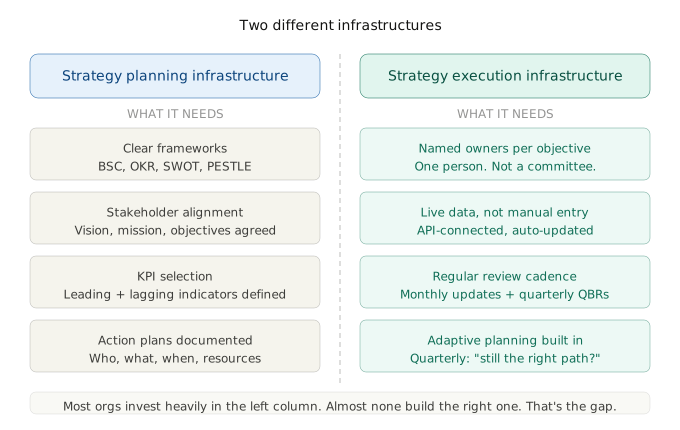
Strategy execution requires a different infrastructure than strategy planning. It demands:
Without these elements, even brilliant strategies become shelf-ware. With them, execution becomes predictable, measurable, and resilient.
Root Cause #1: Phantom Ownership
The most surprising finding in ClearPoint's dataset is this: 81% of strategic measure owners never update their data.
This isn't laziness. It's structural. When strategy ownership is diffused across too many people, when accountability isn't explicitly assigned, and when there's no rhythm to expect or enforce updates, measures become phantom—owned on paper, abandoned in practice. For more on this dynamic, see our guide on strategic planning steps that establish clear accountability.
ClearPoint found that organizations with the strongest execution rates maintain a 7-to-1 ratio of updates to logins. This means that for every time someone logs into the strategy system, they're performing approximately seven data updates or actions. Organizations where this ratio is closer to 1-to-1 (people login but don't update) struggle dramatically with execution.
The solution isn't to hire more people. It's to make ownership explicit and friction-free:
When organizations implement these practices, phantom ownership drops dramatically. Owners feel the weight of responsibility and see that their updates matter.
Root Cause #2: Measure Proliferation
Most organizations measure too much.
ClearPoint's database contains 543,851 measures across 30,000+ plans. This sounds impressive until you do the math: that's an average of 17 measures per plan. Organizations with 5-7 strategic objectives typically create 2-3 KPIs per objective, which is reasonable. But many organizations maintain 15-25 measures per plan, creating what researchers call "metric fatigue." Our strategic planning templates help organizations right-size their measurement frameworks from the start.
When teams are asked to track and update 15-25 measures, several things happen:
The fix is ruthless simplification. Strategy execution frameworks recommend 5-7 measures total across your entire strategic plan. This is counterintuitive for data-driven organizations, but it works. Here's why:
This doesn't mean you ignore other metrics. It means you separate strategic measures (the 5-7 that matter most) from operational measures (managed in departmental systems). Strategic measures are the ones that get reviewed in executive huddles. Everything else is operational detail.
Root Cause #3: Missing Accountability Rhythms
Many organizations treat strategy review like an annual event. The plan is created, approved, filed, then dusted off at year-end for the next planning cycle. In between, there's little to no structured review.
This is a catastrophic design flaw.
Strategy execution requires three distinct review cadences:
Organizations that skip the monthly and quarterly rhythms inevitably discover in the annual review that their strategies failed. By then, it's too late to course-correct.
A structured review rhythm accomplishes several things:
The Strategy Execution Framework That Works
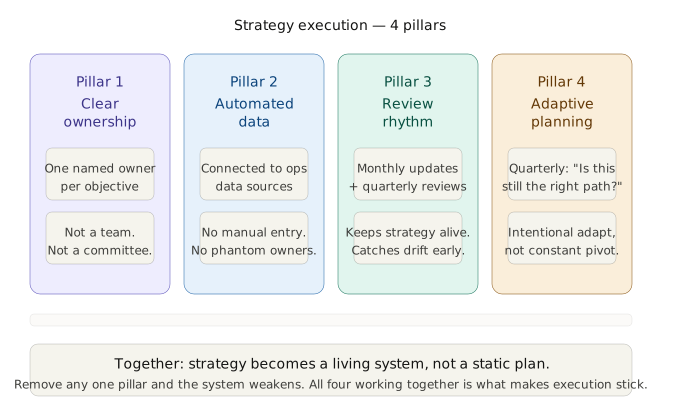
Effective strategy execution rests on four pillars:
Pillar 1: Clear Ownership
Every strategic objective and measure has a single, named owner. Not a team. Not a committee. One person who will be accountable for updates, for problem-solving when targets are at risk, and for communicating status. Backup owners exist for continuity, but the primary owner is crystal clear.
Pillar 2: Automated Data
Stop asking people to manually update strategy measures. Instead, connect your strategy system directly to operational data sources—finance systems, project management tools, dashboards, etc. Automation reduces phantom ownership, improves data accuracy, and frees owners to focus on execution, not data entry.
Pillar 3: Review Rhythm
Build a cadence of regular strategy reviews: monthly updates, quarterly strategy reviews, annual learning cycles. This keeps strategy alive and catches problems early enough to fix them.
Pillar 4: Adaptive Planning
Strategy isn't rigid. Build in a quarterly moment to ask: "Is this still the right approach? Do we need to adjust tactics, resources, or timelines?" This is different from abandoning your strategy every quarter—it's about conscious, intentional adaptation.
These four pillars transform strategy from a static plan into a living, dynamic system.
How Technology Closes the Execution Gap
Manual processes break strategy execution. When strategy management happens through email, spreadsheets, and annual reviews, the friction is too high. Owners go phantom. Measures proliferate. Reviews get skipped.
Technology—specifically, strategy execution software—removes this friction:
The goal of technology isn't to create another tool. It's to make execution friction-free. When the system gets out of your way, execution becomes the path of least resistance.
From Plan to Performance: Connecting the Dots
Strategy execution bridges two worlds: the strategic planning where direction is set, and the performance management where results are delivered. Government agencies benefit from understanding strategic planning for local government, while all organizations should implement KPI dashboard best practices for visibility.
Many organizations treat these as separate functions. Strategy teams create plans. Operations teams execute them. Finance teams measure results. These silos are where execution dies.
The organizations with the strongest execution integrate strategy and performance management seamlessly. This means:
This integration transforms how organizations execute. Instead of strategy and performance being separate systems that occasionally sync, they become one continuous feedback loop.
Learn more about building integrated performance management frameworks and how to align KPIs to your strategy to strengthen this connection. For help implementing these frameworks, explore our strategic planning solutions or schedule a demo.
FAQ
Q: Why do most strategies fail?
A: Sixty-seven percent of strategies fail in execution, not because the strategies are poorly designed, but because execution systems are broken. ClearPoint's analysis of 30,000+ strategic plans reveals three critical failures: phantom ownership (81% of measure owners never update their data), measure proliferation (too many KPIs dilute focus), and missing accountability rhythms (annual-only reviews can't catch problems early enough to fix them). The fix isn't better strategy; it's better execution infrastructure.
Q: What is strategy execution?
A: Strategy execution is the process of turning a strategic plan into measurable results. It's distinct from strategy planning (setting direction) and performance management (measuring outcomes). Strategy execution is about making strategy actionable through clear ownership, structured data systems, and regular review rhythms. It's the mechanism that translates "what we intend to achieve" into "what we're actually achieving." According to ClearPoint data, only 40% of organizational goals remain on track through execution, highlighting how critical this phase is.
Q: How do you close the strategy execution gap?
A: Close the strategy execution gap with a four-pillar framework: (1) Clear Ownership—assign a single, named owner to each strategic objective and measure; (2) Automated Data—connect your strategy system to operational data sources rather than relying on manual updates; (3) Review Rhythm—establish monthly update moments, quarterly strategy reviews, and annual learning cycles; (4) Adaptive Planning—build in quarterly checkpoints to consciously adjust tactics, resources, or timelines as conditions change. Organizations that implement all four pillars see dramatic improvements in execution rates.
%20OKRs%20Meaning%20A%20Practical%20Guide.png)