.svg)
Roughly 77% of strategic objectives have no active owner — here's why phantom ownership is the real execution gap, and how to fix it.
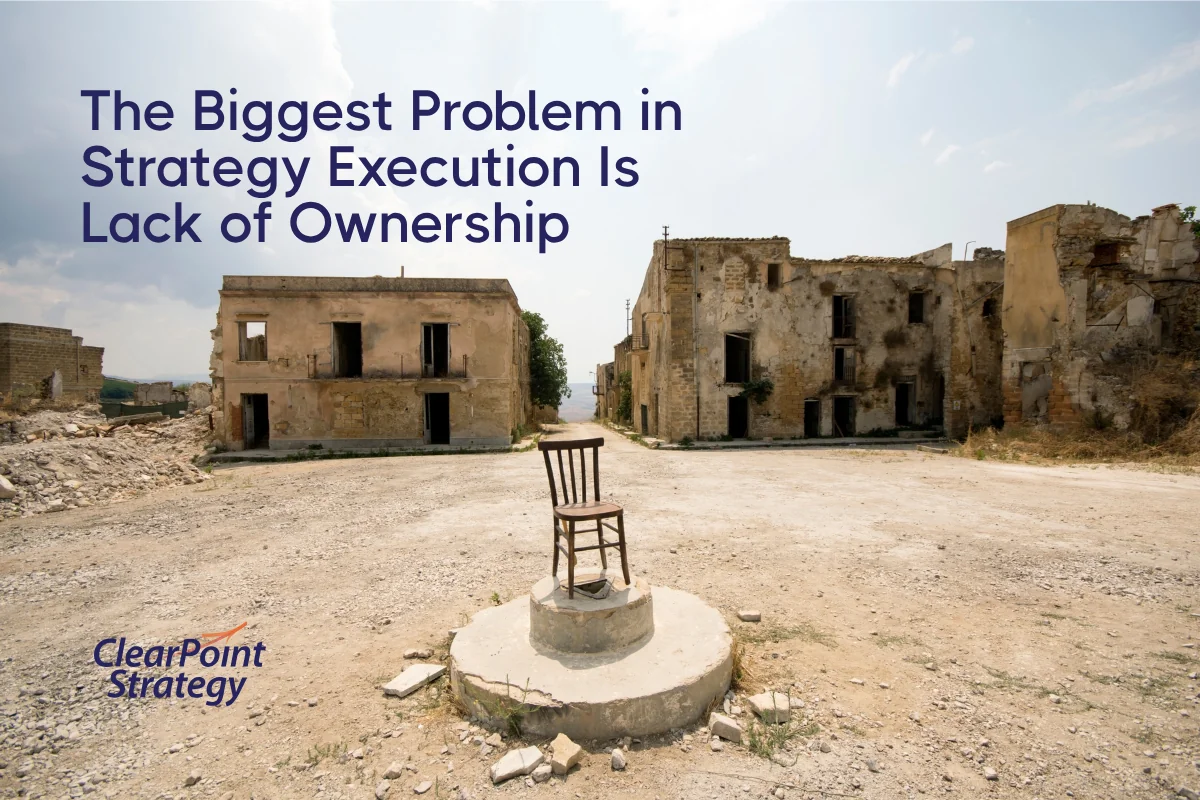
The biggest problem in strategy execution is not bad planning, weak frameworks, or thin budgets. It is that most strategic objectives have no one genuinely responsible for them. In our platform data, roughly 77% of strategic objectives have no active owner — no name attached to the work, or a name that never engages with it.
Those objectives are on paper. In the system. Named in the plan, or waiting for a name that never comes. And nobody is moving them forward.
We see this because ClearPoint sits on one of the larger bodies of real strategy-execution data in the market — hundreds of organizations running thousands of active strategic plans, across government, healthcare, higher education, nonprofits, and the private sector. This is not what executives say they do in a survey. It is what their plans actually look like when nobody is watching.
And what those plans show, overwhelmingly, is that ownership is missing.
Want the full picture? Read our comprehensive guide to strategic planning — the pillar behind this research.
What Is Phantom Ownership?
The strategy world has spent decades agonizing over the "execution gap." Harvard Business Review estimated in 2016 that 67% of well-formulated strategies fail because of poor execution. The Boston Consulting Group has found that only about 56% of strategic initiatives succeed within their planned timeframe. These numbers get cited in every board deck and strategy offsite on the planet.
But they obscure the real problem. "Execution gap" sounds structural — like something you fix with a better framework or a more sophisticated planning tool. Our data tells a different story. The gap is personal. It lives in the space between assigning a name to an objective and that person actually feeling responsible for making it happen.
We call it phantom ownership: the organizational illusion that accountability exists because names appear next to goals.
Phantom ownership:
The illusion that accountability exists because names appear next to goals in a strategic plan. In reality, roughly 77% of strategic objectives have no active owner at all — and even where a name exists, it is frequently a name that never engages with the work.
Consider what that means in practice. If you are a city manager, a hospital CEO, or a utility executive, and you pull up your strategic plan right now, the odds are that most of your objectives have no one truly accountable for them. Your plan looks complete. Your reporting structure looks sound. Underneath, it is a hollowed-out facade.
Why Does Ownership Break Down?
To understand why this happens, look at how most organizations assign ownership in the first place.
The typical process goes something like this. Leadership spends weeks or months crafting a strategic plan. They identify objectives, define measures, scope out initiatives. Then, often in the final stages, they assign owners. The assignment is usually based on functional proximity ("this is an IT objective, so the CIO owns it") or hierarchical convenience ("we need a VP-level sponsor"). The owner's name goes into a spreadsheet or a planning document, and everyone moves on to the next offsite topic.
What is missing is any meaningful conversation about what ownership actually requires: dedicated time, decision-making authority, access to resources, a clear understanding of what success looks like, and — critically — a genuine belief that this work matters.
Without those ingredients, you get what Ron Carucci described in his ten-year longitudinal study for Harvard Business Review: 61% of executives reported they were not prepared for the strategic challenges they faced when they stepped into their roles. If the executives driving the strategy do not feel equipped to own it, imagine how the people three levels down feel when their names appear next to objectives they had no part in designing.
What Does Phantom Ownership Cost?
Our dataset makes the cost painfully visible.
Across the plans we analyze, only about 15% of strategic initiatives are ever completed. Let that land for a second. Organizations spend enormous amounts of time and money — on consultants, on retreats, on planning processes — to produce plans where roughly one in seven initiatives actually gets done.
The performance-measurement systems that are supposed to catch this are part of the problem. Only about 12% of measures are rated green (on-track) across all the measures we track, while a large share are never assessed even once. That is measurement theater: dashboards built to display progress, attached to work that no one is doing.
The pattern is self-reinforcing. When nobody owns the outcome, nobody updates the status. When nobody updates the status, leadership cannot see the problem. When leadership cannot see the problem, nothing changes. And the plan becomes what so many strategic plans quietly become: expensive shelf decoration.
What Does Real Ownership Look Like?
The organizations that crack this do things differently — and the differences are not subtle. The examples below are ClearPoint customers; treat the specific figures as each organization's own reported numbers rather than platform-measured benchmarks.
 Carilion Clinic: building ownership into the system over time
Carilion Clinic, a nationally ranked integrated healthcare delivery system in Virginia, began building its performance-management system after leadership studied the Balanced Scorecard. What it built over the following years is a case study in patience and discipline.
👉 Carilion started with a single leadership scorecard packed with measures, then learned that fewer, more meaningful metrics drove better behavior. Over time the team narrowed the clinic scorecard to a handful of measures tied directly to the strategic plan, and expanded from leadership scorecards to provider-specific scorecards — eventually managing hundreds of scorecards across the organization.
The critical move was tying a meaningful share of provider compensation to scorecard performance. As Carilion has described it, when providers understand what they are being measured on, the organization sees real traction. The scorecards are publicized widely — presented to physicians, management, senior leaders, and the board — so everyone knows what is expected. That is ownership with teeth.
 Edenor: from tactical chaos to strategic alignment
Edenor, the largest electricity distributor in Argentina, serving millions of residents in the Buenos Aires area, spent years operating without formal strategic goals. Teams pursued projects independently, sometimes spending money on efforts that did not contribute to any organizational priority. Budget and strategy were fundamentally misaligned.
👉 When Edenor finally built its first business strategy map, the steering committee did something that sounds simple but is, based on our data, extraordinarily rare: it established specific owners for each objective and assigned explicit KPIs with a defined reporting frequency. The HR team then aligned individual departmental objectives to the organizational strategy, so every team could trace its daily work back to a company-wide goal.
The cultural shift followed. As senior executives saw what structured ownership made possible, more of them wanted in. Teams that had operated in silos began to understand that their work mattered to the broader mission. Edenor moved from a tactical-thinking organization to a strategic one — not because it changed its strategy, but because it finally gave people genuine ownership of it.
 City of Raleigh: people actually using the system
The City of Raleigh, North Carolina — one of the fastest-growing cities in the United States — built its strategic framework around four principles: Envision, Enact, Evaluate, Engage. But a framework is meaningless without the infrastructure to support real ownership.
👉 Raleigh has a large group of people actively working in its strategic-management system, implementing the plan across departments. The city runs cross-departmental initiatives tracked collaboratively, and its CORStat program provides a regular forum for discussing performance, problem-solving across department lines, and holding teams accountable for progress.
Raleigh's strategy team has captured the philosophy well: if you do not offer departments a way to voice the things that matter to them, they will start to resent the strategic plan. Ownership, in other words, starts with inclusion.
The Ownership Playbook: What the Data Says Works
Across thousands of organizations, a pattern emerges among the ones that execute. Ownership works when leaders get four things right.
1. Ruthless focus
The more elements a plan carries, the lower its completion rate. You cannot own what you cannot count on two hands. High performers keep the active portfolio small enough that every objective has a real, capable owner — and they make hard choices about what to leave out.
2. Real accountability infrastructure
Not a spreadsheet. Not a shared drive. An actual system where ownership is visible, updates are expected, and missed deadlines surface automatically rather than waiting for a quarterly review to expose them.
3. Shorter cycles
Annual planning starves accountability; the gap between reviews is long enough that owners disengage. Organizations that move to continuous, shorter review cycles create more frequent moments of accountability — and the pandemic proved that organizations can execute at emergency speed when they decide to. The winners made that speed permanent.
4. Fewer measures, more meaning
The goal is not to measure everything; it is to measure the few things that drive a decision. High performers track enough to act on, with enough granularity to know when to intervene, instead of drowning every owner in metrics nobody reads.
The 10-25 Rule
Our data supports what we call the 10-25 Rule: limit your active strategic portfolio to roughly 10 to 25 critical initiatives per plan. Organizations that exceed this range consistently see completion rates fall.
This matters for ownership because human attention is finite. When a VP is named owner of fifteen different strategic objectives, they own none of them. When a project manager is responsible for a dozen concurrent initiatives, each one gets a fraction of the thought it deserves. The math is simple: more assignments mean less ownership per assignment.
High-performing organizations resist the temptation to put everything in the plan. They make hard choices about what matters most, assign those priorities to people who have the capacity and authority to drive them, and hold those people visibly accountable for results.
Industry Matters, But Ownership Matters More
Ownership gaps vary by sector — but every sector has one. In our data, the share of objectives with no active owner runs to roughly 89% in healthcare, around 80% in higher education, and about 61% in nonprofits. In local government, where reporting tends to be more disciplined, just over half of measures still have no active owner. Initiative completion is in the single digits in healthcare, higher education, and nonprofits, and closer to the high teens in local government.
| Sector | Objectives with no active owner | Initiative completion |
|---|---|---|
| Healthcare | ~89% | ~5% |
| Higher education | ~80% | ~5% |
| Nonprofit | ~61% | ~4% |
| Local government (measures) | ~52% | ~18% |
The variation within industries dwarfs the variation between them. In every sector, the top organizations dramatically outperform their peers. What sets them apart is not their industry — it is their discipline around ownership. Regulated industries such as utilities and financial services tend to perform a little better because regulation creates natural accountability structures: mandatory reporting, external oversight, clear parameters. But any organization in any sector can build those structures intentionally.
The question is not "What industry am I in?" The question is "Does every strategic objective in my plan have someone who genuinely owns the outcome?"
What to Do Monday Morning
If the data in this article has rattled you — good. It should. Here is how to start closing the gap.
Audit your phantom owners. Pull up every strategic element in your plan. Check when each owner last engaged with it. If the answer is "more than 90 days ago," you do not have an owner — you have a name in a field. Reassign or eliminate.
Cut the portfolio. If you are running more than 25 active initiatives, you are almost certainly in the bottom tier. Identify the ten that matter most. Park the rest. Give the people who own those ten the breathing room to actually drive them.
Make ownership visible. Every strategic objective should have a single, named owner with public accountability. Not a team. Not a committee. A person. And that person's progress should be visible to peers and leadership continuously, not surfaced once a quarter.
Tie it to something real. Organizations like Carilion Clinic tie a share of compensation to scorecard performance. You may not go that far, but ownership without consequences is just a suggestion. Performance reviews, compensation, and promotion decisions are the levers that signal what the organization actually values.
Shorten the cycle. Move from annual to quarterly strategic reviews — or shorter. More frequent reviews create more frequent moments of accountability, and more frequent accountability creates real ownership.
How do you make sure every person, on every team, knows exactly what to own? Use ClearPoint.
If your organization is serious about closing the ownership gap, ClearPoint is where you start — because strategy does not fail for lack of planning. It fails for lack of follow-through.
ClearPoint provides the infrastructure that makes ownership visible, measurable, and impossible to ignore. Every objective, measure, and initiative in your plan has a clear owner, and that owner's progress is tracked automatically. When updates lapse, leaders see it immediately. When milestones hit, results are captured and shared. The system makes accountability part of the daily rhythm, not a quarterly ritual.
ClearPoint makes ownership explicit and effortless by:
- Clear ownership assignment: name a single owner for every objective, KPI, project, and milestone — no ambiguity about who is responsible.
- Automated reporting workflows: multi-step reminders, scheduling, and notifications keep updates timely, with no manual chasing or lapsed logins.
- Structured approvals: verify progress through approval flows before reporting, so leadership sees validated updates, not unverified theater.
- Real-time visibility: dashboards, comments, and revision history make progress traceable across teams, surfacing stalls instantly.
- AI-powered nudges: surface insights, assign follow-up tasks, and flag issues early to keep owners focused on what matters.
Ready to audit your phantom owners and build real follow-through? Request a demo today.
Strategy Without Ownership Is Just Expensive Planning Theater
The single most consistent predictor of whether a strategy succeeds or fails is not the quality of the plan, the sophistication of the framework, or the size of the budget. It is whether someone wakes up every morning feeling personally responsible for making a specific part of that plan happen.
That is ownership. And with roughly 77% of strategic objectives carrying no active owner, we have an epidemic.
The fix is not complicated. It is uncomfortable. It means saying no to the eleventh priority. It means having honest conversations about who can actually drive what. It means building systems where accountability is not aspirational but mechanical. And it means leadership treating strategy execution with the same operational rigor they apply to managing the P&L.
The organizations that will dominate the next decade are already doing this. The data shows it clearly. The only question is whether you will join them.
Frequently Asked Questions
What is the biggest problem in strategy execution?
The biggest problem is lack of ownership. In ClearPoint's platform data, roughly 77% of strategic objectives have no active owner — and even where a name is attached, it is often a name that never engages with the work. Plans stall not because the strategy is wrong, but because no one feels personally responsible for the outcomes.
What is phantom ownership?
Phantom ownership is the illusion that accountability exists because a name appears next to a strategic objective, measure, or project. The name is in the system, but the person never updates the element or drives the work. It is the single most common pattern we see in strategic plans.
How does ownership affect whether a strategy gets executed?
It roughly doubles the odds of staying on-track. In our data, strategic objectives with an active owner are rated green about 23.6% of the time, versus about 9.7% for objectives with no owner — more than a two-times difference. Ownership is the most reliable single predictor of execution we measure.
What is the 10-25 Rule in strategy execution?
The 10-25 Rule recommends limiting an active strategic portfolio to roughly 10 to 25 critical initiatives per plan. Beyond that range, completion rates fall, because human attention and execution capacity are finite. When owners are spread across too many priorities, they cannot give any one of them enough focus to succeed.
How do high-performing organizations build real ownership?
They keep plans focused, assign a single named owner to each element, make progress visible continuously rather than quarterly, shorten their review cycles, and tie ownership to real consequences such as reviews or compensation. They treat accountability as an operating discipline, not a formality.
How many strategic initiatives actually get completed?
Across the plans ClearPoint analyzes, only about 15% of strategic initiatives are ever completed — roughly one in seven. Completion is lowest in healthcare, higher education, and nonprofits, and somewhat higher in local government, where reporting tends to be more disciplined.
See ClearPoint in action.See the strategy management platform that has delivered results for other top performers. In 30 minutes we will show you how to turn your strategy into an actionable roadmap you can start using immediately. |