What should you focus on to link you budget to your strategy?
- Define long-term goals before choosing a budgeting approach. Then build a 3-5 year strategic plan and a 1-2 year budget tied to it.
- Pick the budgeting method that fits your organization. Priority-based, zero-based, budgeting for outcomes and base budgeting can all link to the strategic plan.
- Confirm each department budget links to the strategy. Compare against last year's budget only to test assumptions, not to recycle old requests.
- Create a separate StratEx budget for strategic projects. It cuts across departments and designates funding for the projects that carry the strategy.
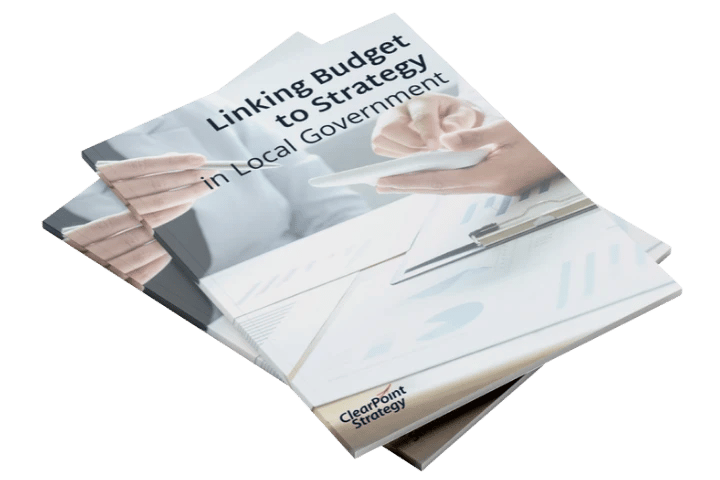
- Revisit budget allocations after each strategy meeting. Plan that cadence with the free Linking Budget to Strategy whitepaper.
If your organization is weary of an eight-month budgeting process, ask whether the budgeting process helps it find value or whether everyone is just recycling budget requests from previous years. By tying budget to strategy, you can help staff better understand how decisions are made and create connections to the big picture as you work toward shared goals.
Local Government Budgeting Process
Whatever your budgeting approach, you can link it to strategy so people see the value in budget development. When you link budget to strategy, you can stop dreading the budget process and get inspired by it instead.
With regular management and meetings, a linked budget and strategy allows your organization to achieve its long-term priorities. In 2020, we conducted a survey among local governments to learn more about their budget and strategy alignment, reporting, and results. The results show the positive impact of close alignment between budget and strategy as well as consistent, regular reporting processes.
Here's how to align strategy and budget in your organization:
- Start by clearly defining long term goals (the first step in building your strategic plan).
- Define the budgeting process. Four options for approaching your budget: priority-based budgeting (PBB), zero-based budgeting (ZBB), budgeting for outcomes (BFO), and base budgeting.
- Communicate strategy and budgeting process clearly to departments, and ensure department budgets link to strategy.
- Compare previous budget to plans (not to continue previous budgeting process, but to check your assumptions).
- Consider creating a StratEx budget: a separate, cross-departmental part of the bigger budget that designates strategic project funding.
- Manage your budget within a strategy management cadence. Be aware of strategy reporting and decision making, revisit budgets after strategy meetings, and provide appropriate reporting for decision making.
Linking Your Budget to Long-Term Goals
Just like your strategy, your budget needs to be linked to your long-term goals. Once you’ve developed those long term goals, you can start to build your 3-5 year strategic plan and a 1-2 year associated budget. When building your strategic plan, involve your stakeholders, including staff and residents. Set bold, but realistic goals that take into account your organization’s strengths and weaknesses.
When creating the plan, align departments with the overall strategy. Each department should support the overall strategy, and departmental plans that tie departmental efforts to organizational strategic goals can make this alignment clear.
Any of the budgeting approaches below can link to your strategic plan. One size does not have to fit all; however, some are more comfortable fits depending on your organization.
Four Types of Local Government Budgeting
Different budgeting processes make it easy to link your budget to your long-term goals.

Priority-based budgeting
Priority-based budgeting (PBB) involves linking budget priorities to your strategic plan goals. PBB is driven by the idea that the initiatives and programs that support an organization’s priorities are those that should be funded by the budget. This data driven approach ensures that all funding dollars help the organization work toward its high-level goals and that program budgets are allocated based on true priorities.
If you have communicated your strategy well, and if you have a living strategic plan, your organization should already understand these goals, and thus priority-based budgeting is a natural outcome.
Zero-based budgeting
If you are using zero-based budgeting (ZBB), you take a similar approach: you build your budget from the ground up based on the priorities. However, with zero-based budgets, you don’t build off of last year’s budget; you start from zero, and then build from what you need. This might be a great approach for the current environment.
Zero-based budgeting helps to establish an organizational culture of ongoing cost management. It relies on increased visibility into what drives the costs of each budget item and requires setting aggressive budget targets going forward to ensure a balanced budget. Continuous reviews of cost management and performance are also essential to its success.
Budgeting for outcomes
Budgeting for outcomes (BFO) is similar to priority-based budgeting, but it focuses on outcomes the organization is working towards rather than priorities. Imagine your outcomes are either your strategic plan goals or the measurable results from your strategic plan. Budgeting for outcomes allows local governments to create alignment between what the public wants and what the governments provide.
A key tenet of budgeting for outcomes is a focus on what you want and how much you’re willing to pay for it (as opposed to assessing what you currently have and how much it costs). The process will demand a lot of reorganizing, but your strategy and budget will benefit as a result.
A good place to start with budgeting for outcomes is to look at how much funding you have and then ranking your goals based on priority. You can then allocate money to the outcomes with the highest priority and continue distributing money until the funds are spent.
Base budgeting
Base budgeting uses the current year’s budget as the baseline for the new budget. The current year’s budget and allocations are adjusted according to actual spending that has occurred throughout the year as well as inflation and projections for the upcoming year; this forms the basis of the new budget.
You may be starting to see a pattern in these budgeting approaches. We’re not saying they are the same; certainly, different organizations have seen different results and benefits from each. But with a little creative thinking, you should be able to guide your organization to linking its budgeting approach to the strategy management process.
Linking Budget and Strategy in Healthcare
Hospitals and health systems link budget to strategy the same way, often with two more approaches. A rolling forecast re-forecasts the next twelve months at the end of each quarter. It helps when conditions change quickly, though it takes more meetings and analysis to keep current. Initiative-based budgeting starts from each proposed initiative: identify its key drivers, such as revenue and reimbursements, patient volumes and the cost of delivering care, then model its financial and operational impact over time.
A StratEx Budget Example
A StratEx (strategic expenditure) budget sits above normal department budgets, such as Surgery and Rehabilitation, and funds the cross-departmental projects the strategic plan needs. Imagine a $5M strategy budget allocated 40% to state-of-the-art facilities, 30% to a well-trained workforce and 30% to cutting-edge research. Facilities get $2M: list every project that aligns with improving facilities, prioritize them and fund them in order. Training and research get $1.5M each. Norton and Kaplan first wrote about StratEx in their book The Execution Premium.
See how ClearPoint links your budget to your strategy — book a demo
Common questions
How can I communicate my budget?
It's important to communicate your local government's budget objectives, as well as the budget performance throughout the year. There are many ways to share your budget both internally and externally including with budget books, press releases, presentations, and via social media. When sharing your budget, you may want to consider also sharing the overall progress of the goals your budget is tied to with a performance management tool or dashboard.
How can I engage residents in the annual budget process?
Budgeting decisions directly affect residents and the places that they live and work. To ensure support of the strategic plan and budget, regardless of the types of budgets that you are preparing, engage your residents in advance through surveys, open houses, forums, and panels. Many organizations also provide a place online where residents can review the budget priorities and performance and provide feedback.
What steps are involved in preparing a budget?
The budget preparation process varies by organization and the budget format that your organization uses. All budgeting processes should start by defining your organization's high-level goals. Typically, this is when you want to get feedback and input from internal stakeholders (like your City Manager and Department Directors) and external stakeholders (like residents and local businesses). Then, you'll need to choose which budget process you're going to use and educate all members of your budget office on the process. You'll also need to ensure you have a process for departments to submit budget requests both during and after the annual budget process.
What are the benefits of budget planning?
When done correctly, budget planning has many benefits for a local government and its community. By engaging and sharing progress, local governments increase transparency and trust. Multi-year plans help to ensure decision-making is long term, and by tying budgets to goals, they can be shifted as priorities shift.